
This is Part 1 of a two-part series. Part 1 covers what an L&D strategy actually is and what it looks like when you get to play it on purpose. Part 2 is for when you don’t get to play chess…yet, and what to do in the meantime.
“Be More Strategic.” Okay. But What Does That Actually Mean?
There’s a specific kind of quiet panic that hits when someone says “we need an L&D strategy” and looks at you like you’re the one who’s supposed to know what that means.
Not because you don’t care. Not because you haven’t been paying attention. But because strategy, as a word, carries weight. It feels like you’ve been dropped into the Queen’s Gambit without anyone telling you.

Chess looks intimidating if you’ve only ever played checkers. Same board. Very different game. And when everyone around you seems to already know the moves, it’s easy to assume the gap is you. But here’s what you haven’t considered: you’ve been making strategic moves your whole career. You just didn’t have a name for them.
The goal of this post isn’t to hand you a 52-step strategy framework. It’s to show you the game you’ve actually been playing, and what it looks like when you get to play it on purpose.
Chess vs. Checkers: It’s Not an Insult
Checkers is reactive, with all the pieces being equal. You move when it’s your turn. You respond to what’s directly in front of you. In L&D terms: someone requests training, you build training, you deliver training. Wash, rinse, repeat.
Chess is anticipatory, with each piece serving a distinct purpose. You’re reading the whole board, thinking three moves ahead. You’re making decisions before the work starts that determine whether your work actually lands, or gets quietly buried in the LMS to gather digital dust.
Many L&D professionals are playing checkers. Not because they lack the instinct for chess. But because the system they were hired into handed them a checkers rulebook, and measured them on how fast they could move pieces.
That’s not a professional failing. That’s the system talking. The one you didn’t have a hand in building.
What a Learning Strategy Isn’t
Before we talk about what strategy actually is, let’s talk about the rulebook most of us were handed instead. Because odds are good you’ll recognize yourself somewhere in here.
A training request form isn’t a strategy. It’s an intake process. An important one, sure, but fielding requests isn’t the same as directing organizational capability. Neither is a course survey, which tells you whether people liked the experience but almost nothing about whether behavior changed or a business result moved. An annual training calendar is a schedule. A learning management system is infrastructure.
None of these things are bad. They’re solid tools. Just not for the moment everyone’s suddenly asking you to show up for.
If you’ve been measuring your impact in completion rates and smile sheets, don’t feel bad. You were doing exactly what the checkers rulebook told you to do.
So What Is a Learning Strategy, Actually?
At its core, strategy is two things.
It’s knowing which game you’re playing before you make a move. Not what training someone asked for but what the organization actually needs to accomplish, and where the gaps between here and there live. Are you in a company trying to scale fast? Bleeding talent and desperate for a retention story? Facing a product launch with a sales team that isn’t ready? The game looks different in each situation, and your moves need to match the board you’re actually on. Not the one from January’s goal-setting session.
And then it’s about making decisions that shape the work before the work starts.
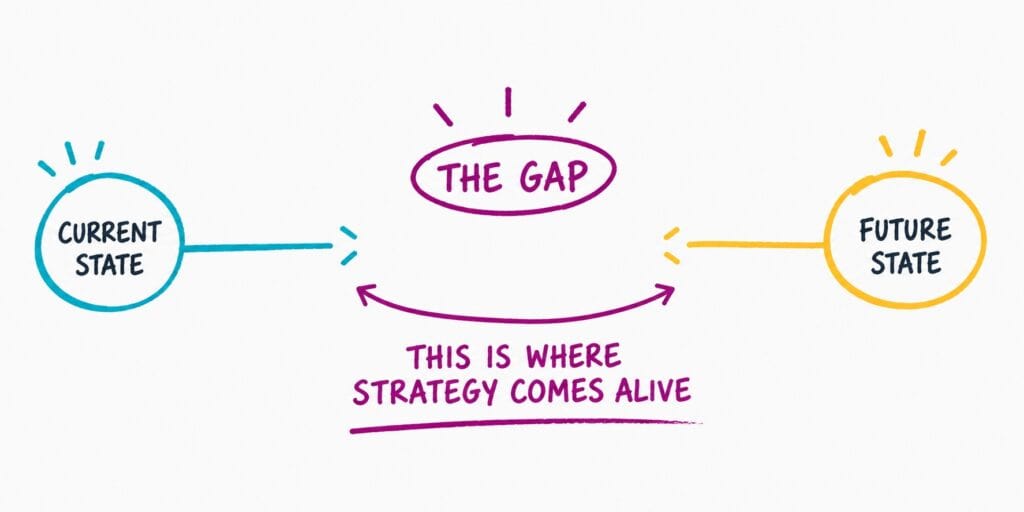
This is where many L&D leaders lose ground they don’t get back. They jump straight to execution without investigating the gap. They’re building, delivering, launching, all before anyone has answered the questions that determine whether any of it matters. What’s the real problem underneath the request? What does success look like in language leadership actually tracks? Who needs to be invested in this for it to survive contact with reality?
That’s it.
Not a framework. Not a certification. It’s a way of entering the work differently, with questions instead of assumptions, and outcomes instead of outputs.
And here’s the part you need to know: if you’ve ever pushed back on a vague training request because something felt off, you were already thinking strategically. If you’ve ever asked “but what are we actually trying to change?” you were already thinking strategically. The instinct was always there.
The system, however, was only built for checkers.
Reading the Board
Here’s where strategy stops being abstract and starts being something you can actually see.
Every organization has the same five pieces on the chess board. Executives with budget. Middle managers with influence. Employees on the ground. The IT, compliance, and legal functions moving at angles. And the business goal sitting at the center of it all? That’s the king everyone is trying to protect.
Here’s what most L&D professionals don’t realize: those are your five pieces too. You’re not watching this game from the sidelines. You’re on the board (whether you realize it or not). The difference is that each player sees those pieces through their own lens. The executive sees retention risk. The middle manager sees their team’s bandwidth. The employee sees whether this is worth their time.
And you? You are trying to see the capability gap beneath it all.
Same five pieces. Very different views of the board.
Without question, you will lose pieces along the way. A champion gets promoted out. A budget gets cut. A manager who had your back takes a new job across the country. That’s not a sign you need to start over. It’s about adjusting. That’s the game. The goal isn’t to keep all your pieces forever. It’s to know which ones you’re working with right now, which ones you have to sacrifice, and then plan your move accordingly.
Because there’s always a king. A business goal worth protecting. Sometimes even the king changes, that’s okay. Your job is to know which king you’re trying to protect right now.
What a Learning Strategy Looks Like When It’s Working
You know the time has come when a business leader calls you…out of the blue. Not with a training request, but with a problem. Sales are flat in a specific region. A product launch is six months out, and the customer service team isn’t ready. Tenured people are leaving faster than anyone is capturing what they know.
And instead of reaching for a course template, you already know the capability gaps in that region. You’ve had the conversation with HR. You saw the product launch on the organizational calendar three months ago and started asking questions then. You know which middle manager will champion this and which will need convincing.
You didn’t wait to be handed the problem. You already knew it was coming.
That’s chess. That’s you being intentional.
And that version of you isn’t a different person with a different title or a bigger budget. It’s you, thinking about the work differently. Asking questions earlier. Connecting dots that nobody asked you to connect. Protecting the king before anyone named which king needed protecting.
That shift starts the moment you stop waiting for the checkers rulebook to become a chess manual.
(If you’re reading this thinking, “I get it, but my organization would never let me play this game right now.” I see you. That’s a real situation, and it’s not your fault. I wrote about it here: It’s Not You, It’s the System.)
Your First Strategic Moves
So where do you start?
Not with a framework. Not with a strategy document that takes three months to write and lives in a shared drive nobody opens.
You start with a question.
This week, find one request sitting in your inbox and ask what’s underneath it. Not “what do they want built,” but what business problem is this actually solving? You don’t have to say it out loud to anyone yet. Just practice seeing the board differently.
Then find the king.
Look at what your organization is publicly chasing right now: a growth target, a retention problem, a compliance issue, or customer service adjustments. Then, ask yourself honestly: does anything L&D is currently doing connect to that? If the answer is murky, that’s not a failure. That’s your starting point.
And the next time you’re in a room with a business leader, ask one question and then stop talking. “What would a win look like for your team this year?” Then listen. Not for a training request. Listen for the king. Because what they say next will tell you more about the board you’re actually playing on than any strategy document ever will.
That’s three moves. None of them require a new title, a bigger budget, or an organization that’s figured any of this out yet. They just require you to start thinking like someone who’s playing chess, which, as it turns out, you already are.
If this post hit a nerve and you want to think through what playing chess looks like in your specific situation, let’s talk. A 20-minute conversation costs you nothing and might reframe everything.
Part 2 is here, and it’s for everyone who read this and thought, “I get it, but that’s not where I am right now.” Maybe you’re under-resourced, or you don’t have strong relationships yet. It could be you inherited a function with a crappy reputation you didn’t earn.
Checkers, played smart, can still move you toward the chess table. That’s next.
