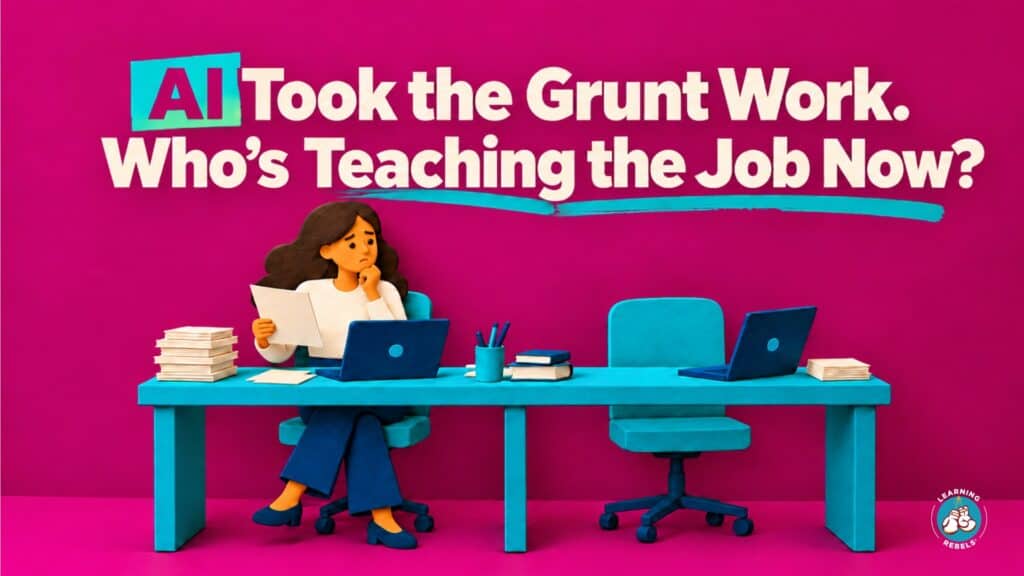
Remember your first real job? The job where you did “entry-level” work?
Formatting the boss’s slide deck at 9 p.m. Finding the errors in the department pivot table. Taking notes in a meeting where you understood maybe half of what was being said, then trying to write the follow-up report? We’ve all been there, done that, and bought the crappy t-shirt.
Nobody put that kind of work on their career dream board, but it was necessary. This work was a foundational part of your career ladder.
Now fast-forward: AI writes the first draft of a report, designs PowerPoints, cleans up the quarterly spreadsheet’s poor formatting, and summarizes the stakeholder meeting before anyone has finished their coffee.
Efficient? Absolutely.
But it raises a question most organizations haven’t asked yet. If the bottom rung of the career ladder is gone, how exactly is anyone supposed to climb?
This question kept nagging me after I joined the Talent Talks podcast hosted by TalentLMS to talk about skills visibility. The more I thought about it, the clearer it became: AI makes skills visibility urgent, not optional.
Who’s standing in the AI blast zone?
This isn’t a robots-are-coming-for-us post. It’s a post about organizational structure. So first, a little data.
Researchers at Stanford’s Digital Economy Lab, working with ADP payroll data, found that workers aged 22 to 25 in the most AI-exposed occupations saw a 16% relative decline in employment after generative AI went mainstream. Meanwhile, employment for experienced workers in those same jobs stayed stable. The decline showed up where AI automates the work, not where it supports the people doing it (Brynjolfsson, Chandar & Chen, “Canaries in the Coal Mine?”, Stanford Digital Economy Lab, 2025).
So who’s standing in the AI blast zone?
Software developers, customer service reps, computer programmers, and information systems managers are all roles where AI already handles a big share of the core work (MIT Technology Review, 2026). In software engineering and customer service, entry-level employment fell roughly 20% between late 2022 and July 2025, while employment for older workers in those same jobs grew (CBS News, 2025).
Freelancers are feeling it too. In the eight months after ChatGPT launched, freelance job postings in writing and programming dropped about 21%, and job posts related to image creation fell 17%; these are all skills AI tools handle efficiently (Demirci, Hannane & Zhu, Management Science, 2025).
To be fair, not every economist is convinced AI is the main culprit. Some argue that a broader hiring slowdown, which usually hits new grads first, explains a good chunk of the job decrease pattern (Economic Innovation Group, 2026).
Fine.
But let’s not miss the point. Whatever the cause, the result for the 24-year-old trying to get a foot in the door is the same: fewer doors and fewer rungs available to them.
The grunt work was the learning
The people who do get hired are walking into roles where the “grunt work” tasks are already handled by some sort of tool (be it AI or software).
Those foundational tasks did a lot of heavy lifting. After building your fiftieth report, you notice when number fifty-one looks off. After making a hundred small, low-stakes decisions, you start recognizing trends and themes that allow you to make bigger decisions more confidently.
After a year of cleaning up messes, you know who to call when the system crashes and which shortcuts will get you in trouble. And you learned it all sitting 10 feet away from someone who had been doing it for a decade.
None of this learning was a course in an LMS or covered in a “Lunch and Learn.” It was baked into the work. Pull the work out, and the learning leaves with it. This is an organizational culture issue that frankly isn’t being discussed enough in leadership meetings.
Who becomes senior if nobody gets to be junior?
This is exactly what should be making leadership more than a little twitchy. Every senior analyst, experienced nurse, top-performing salesperson, and seasoned operational manager in your organization was once somebody’s rookie.
They learned the job by doing the job.
Organizations trimming the bottom rung to save on headcount are borrowing against their own future. The bill will become due soon when the senior people retire or move on, and there’s nobody behind them who has done the reps.
The marketing industry offers a preview of where this is heading, and Gartner is pretty much standing on a mountain and shouting it out. Gartner predicts that by 2030, AI will allow for many high-performing marketing teams to “eliminate the traditional bottom rungs of the corporate ladder.” Of the 1,300 marketing leaders Gartner surveyed, 18% have already cut early-stage marketing roles because of automation (Marketing Week, 2026).
Where do these skills get built now?
Gartner’s research also notes that skills like communication, empathy, and relationship building used to develop over time through exposure to senior leaders. Now, new marketers are expected to show up with these skills already built and ready to hit the ground running.
Which raises the obvious question: built where, by whom?
Right now? If we keep letting this gap grow? Nowhere and no one.
The places those skills used to grow (the client call you sat in on and the debrief afterward) were all attached to the junior work.
None of this comes from practicing with an AI coach alone. Empathy and judgment are learned by watching someone else use them, then trying them yourself while someone watches you. No one is building a pipeline for this type of skill development.
Some leaders see this coming. In a widely shared New York Times op-ed, LinkedIn’s Aneesh Raman argued that companies need to keep hiring young workers or run short on future leaders, and that entry-level jobs should be redesigned around higher-level work. At KPMG, for example, new grads now handle tax assignments once reserved for people with three or more years of experience.
Fair enough.
But handing someone harder work isn’t the same as building the judgment to do that work well.
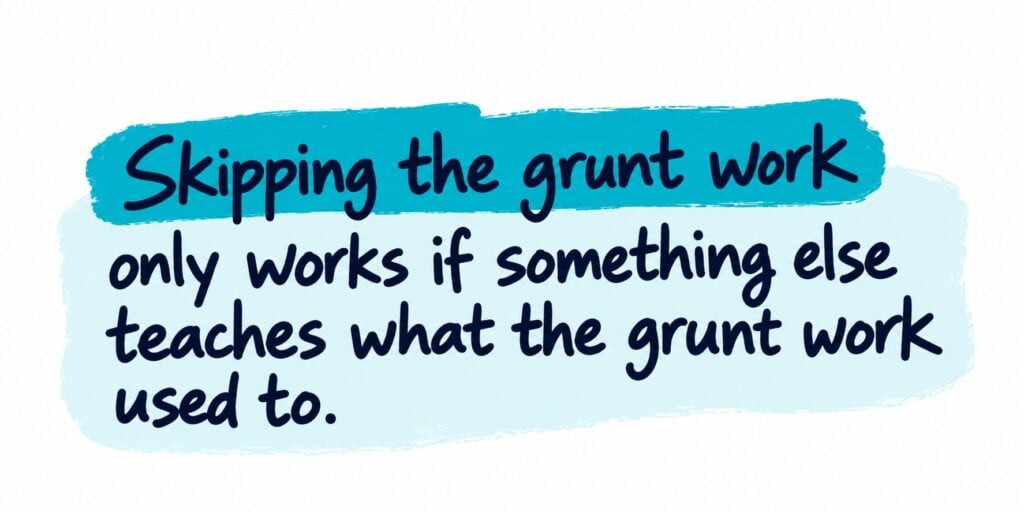
Meanwhile, job postings get less relevant by the week. “Entry-level position. Three to five years of experience required.”
Three to five years of what experience, exactly?
Organizations still want experience, but they’ve stopped offering the “experiences” that go with it. That’s like demanding a sourdough loaf after tossing out the starter.
Skills visibility: you can’t rebuild a rung you can’t see
During the Talent Talks conversation, the numbers that came up told a bigger story. TalentLMS research found that almost 8 in 10 HR managers say they’re moving toward a skills-based approach for hiring, training, and career development. Yet according to Gartner, only 8% of organizations have reliable data on the skills their workforce actually has.
So, eight in ten want to be skills-based, but roughly only one in twelve knows what skills they’re working with. The math isn’t mathing.
Within our conversation, I used financial acumen as an example. It’s a foundational competency that looks great on a leadership framework. But what’s the skill underneath it? Well, for one: being able to read financial reports and tell the story behind the numbers. And where did most of us learn to do that? By building P&L decks for the boss, over lots of coffee and Tylenol.
If AI builds the deck now, how does Joe, the new accounting dude, learn how to tell the story?
That’s what skills visibility means in a workplace that runs on AI. It isn’t buried within an HR competency spreadsheet. It’s knowing which skills your business depends on to succeed. Then, which of those skills were built into the old entry-level work by accident, and where the gaps show up now that the accident isn’t happening anymore?
Let’s Reimagine a New Way of Addressing the Skills Gap
A new hire starts on Monday.
Instead of an endless PowerPoint covering the CEO’s 50-year backstory, they build a 30/60/90 plan with their manager that names the skills the role requires and how they’ll get there from here.
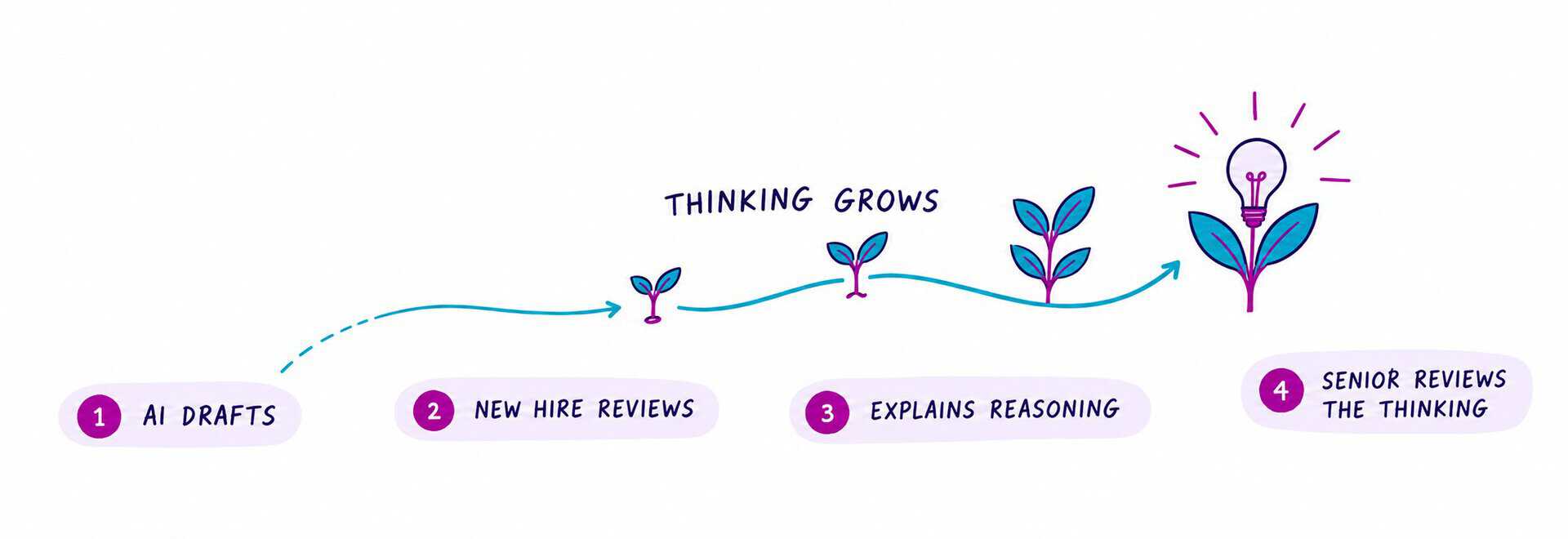
AI can still write the first draft of the customer report. But the new hire’s job isn’t to accept it. Their job is to find what’s wrong with it, fix it, and explain the fix to a senior colleague who reviews their reasoning, not just their output.
The tool does the typing.
The human does the thinking, and someone is watching that thinking grow.
Six months in, the manager can say with confidence, “She’s ready to handle client renewals on her own,” because they know what “ready” looks like and they’ve seen her do it. Not because she completed four modules and downloaded a certificate.
Now we’re talking. We’ve created a new space for people to grow.
Four ways to put the rung back
You don’t need an enterprise-wide skills overhaul to start. Please don’t start there. Big changes make people protective of their space. Pick one department team. Then:
- Ask the failure question, with an AI twist. On the podcast, I talked about asking managers, “What would make your department fail?” Managers understand what failure looks like. Now add a follow-up: “If AI handles the bottom 30% of this job, what would a new person never get the chance to learn?” Write down what they say. That’s your missing-rung list.
- Redesign the work, not just the training. Turn AI output into practice material. Have early-career staff critique, correct, and defend their changes to AI-generated work. Build in shadowing and “walk me through your reasoning” moments with experienced colleagues. The goal is deliberate reps, not another training course.
- Check progress at business moments, not once a year. By the time the annual review rolls around, you’re 364 days behind. When a new product launches or a process changes, ask: Did people have the skills we needed? Did they use them? Keep the skills data small and current, and tell the story behind it. Leaders don’t want another spreadsheet. They want to know who’s ready and who needs help.
- Listen to what people are asking AI. The questions employees type into tools like Microsoft Copilot are a running list of what they don’t know yet. In Microsoft 365, those prompts are captured in the organization’s audit logs, so partner with IT to pull the themes, not the names. If dozens of people are asking Copilot how to read a variance report or handle a tough client email, that’s a skills gap hiding in plain sight. Bring those patterns to leadership as evidence. One ground rule: keep it anonymous and tell people the what, why, and how behind the actions. The fastest way to stop people from asking questions is to make them feel watched.
So, Now What?
Learning by watching is about as old as people are. Long before anyone had a job title, someone older pointed out the danger signs while someone younger paid attention.
Apprenticeship works. That part hasn’t changed.
What’s changed is the setup. For generations, the work itself kept new people close enough to learn. We counted on that and never had to design it. Now we do, especially with the hybrid working model many organizations have implemented.
Organizations that get clear on the skills they need, and honest about the gaps opening underneath them, will have people ready to step up when senior folks step out. The ones that don’t will keep wondering why their bench is empty.
FAQ
How do I get leadership to care about skills gaps?
Speak their language. Leaders respond to risk, revenue, and results, not competency models. Connect each gap to something they already worry about, like missed deadlines, customer complaints, or turnover in a key role. Bring a few concrete examples, keep the data simple, and suggest a small pilot with one team. A quick win builds more support than a big proposal.
What is skills visibility?
Skills visibility means knowing which skills your organization depends on, who has them, and where the gaps are. It isn’t a giant competency spreadsheet nobody opens. It’s current, practical insight into the skills behind the work, including the ones people used to build through entry-level tasks that AI now handles.
How do I discover the skills gaps AI is creating?
Start by asking managers two questions: “What would make your department fail?” and “If AI handled the most routine parts of this job, what would a new person never get to learn?” Their answers point straight to the skills that matter and the ones entry-level work used to build. Then watch how people perform during real business moments, like a product launch or a process change, to see where the gaps actually show up.
I’m in an entry-level role. How do I close my own skills gap?
Don’t wait for the grunt work to teach you. Ask to sit in on client calls, project debriefs, and meetings where decisions get made, even if your only job is taking notes. When AI gives you a first draft, critique it before you use it, and ask a senior colleague to review your reasoning, not just your output. Then ask your manager one question: “What does ‘ready for more’ look like in this role?”
How do you close a skills gap without adding more training?
Start with the work itself. Give people stretch assignments with support, pair them with experienced colleagues, and build feedback into everyday tasks rather than saving it for a classroom. Job aids, checklists, and short practice moments often close gaps faster than a course. Training is one tool, not the default answer. If the gap shows up on the job, the fix usually belongs there too.
Can I use Microsoft Copilot data to find skills gaps?
Yes, with help from IT. In Microsoft 365, Copilot prompts and responses are captured in the organization’s audit logs and can be reviewed through Microsoft Purview. L&D usually won’t have direct access, so partner with IT to pull common themes. If you find that many people are asking how to do the same task, that’s a skills gap worth addressing.
Want the full conversation? Listen to the Talent Talks episode on skills visibility. And if you’re wrestling with this in your own organization, bring it to the next Learning Rebels Coffee Chat. This is exactly the kind of problem we work through together.