
You already know that training by itself won’t do the job. This ain’t new news.
What you’re up against is the stakeholder who wants “a training” for every new process, the director who thinks a two-hour workshop is the whole solution, and nothing but the solution.
It can be frustrating when nobody wants to hear there’s more to learning than slapping together a workbook and PowerPoint deck.
Okay, so what do you do? In this post I’m giving you the actual research you can use at the next stakeholder meeting on why a single event was never going to hold up on its own, and specifically what needs to exist around it for the learning to survive past the first Tuesday back at the desk.
Bring this to the next kick-off meeting to help you have a conversation that may just produce a stronger learning experience.
Why “just add more training” was never going to work
For some reason, stakeholders picture learning like pouring water into a glass. Run the session, information goes in, done. Under that model, if the learning didn’t stick, the obvious fix is to pour more. Provide a longer course, a follow-up webinar, or a refresher deck nobody reads.
Here’s what we need to be able to explain to stakeholders: That’s not how learning works, and it hasn’t been the accepted model in cognitive psychology for decades. Plus, there are times when our own cognitive biases get in the way. Therefore, it’s time to get our science groove on.

Let’s Talk Constructivist Theory.
The framework most learning science has operated from since the mid-20th century. Constructivist Theory (Jean Piaget) treats learning as something the brain builds, not something it receives. The active construction of knowledge. New information gets constructed on top of existing knowledge, tested against what the person already believes and does, and is either integrated or discarded. A process that the brain begins with the basic task of organizing knowledge and then grows more complex as new information is added.
Nobody walks out of a training session with a finished structure. They walk out with a foundation and maybe a few walls.
This is why the “pour more in” instinct backfires. You can’t fix a half-built structure by dumping more materials on the pile. You fix it by giving the builder time and support.
Translated for the humans in the room: The training event is where construction starts. If nothing happens after the foundation is laid; no chance to apply the new skill, no one checking whether it held, no support when the old habit tries to reappear, the structure stays half-built. And half-built structures fail.
This discussion matters, because it moves the conversation from “the training needs to be better” to “a system around the training needs to exist.”
Lever #1: Nobody’s being asked to retrieve anything
Here’s a phrase to tuck into your brain: the testing effect.
Cognitive psychologists Henry Roediger and Jeffrey Karpicke ran a now-famous set of studies comparing two ways of studying the same material: rereading materials and notes versus being asked to actively recall them from memory.
The rereading group felt more confident.
But spoiler alert: The recall group remembered more, and the gap got bigger over time, not smaller.
There’s a reason for that. Every time someone pulls information out of long-term memory and back into working memory, the mental pathway to that information gets stronger and easier to access next time.
Retrieval strengthens the memory. The act of recalling something isn’t neutral; it’s a rep. Skip the reps, and the pathway stays weak no matter how well the content was originally delivered.
This is why rereading and rechecking notes seems to be a logical studying technique but is actually a myth. It creates what is called the “illusion of competence.” After rereading, the material feels familiar, so people assume it’s learned.
But familiarity isn’t retrieval. Recognizing an answer is not the same skill as producing one from memory, and that production is where the rubber meets the road.
Now, look at a typical training event: content delivered once, maybe a quiz at the very end to check the “completion” box, a smile sheet completed and a fond farewell. And then nothing. No one is ever asked to pull that information back out of their head again after day one. It’s the equivalent of doing a single rep with a 5lb weight and calling it strength training.
How do you explain this to stakeholders? Retrieval, not repetition, is what makes learning durable, and every retrieval attempt makes the next one easier. And it doesn’t require extra work. It requires one of three things:
- The automated version (zero manager lift): write a few scenario-based questions and schedule them via email (or other communication channel) to send 5, 10, 15 days after training.
- The embedded version: Ask managers to add one agenda line to a team meeting, a 60-second “walk me through how you’d handle X”, rotating who answers. L&D’s only job is writing the prompt and handing it to the manager.
- The peer version (no manager involvement at all): pair two people who sat through the same training for 15 minutes as a “pair and share” for reinforcement. This can be over coffee or Slack, no agenda beyond the prompt L&D hands them.
Any (or all) of the above will move the learner from a 5lb rep to 20 lbs of strength training.
Lever #2: The support got pulled before anyone was ready to stand without it
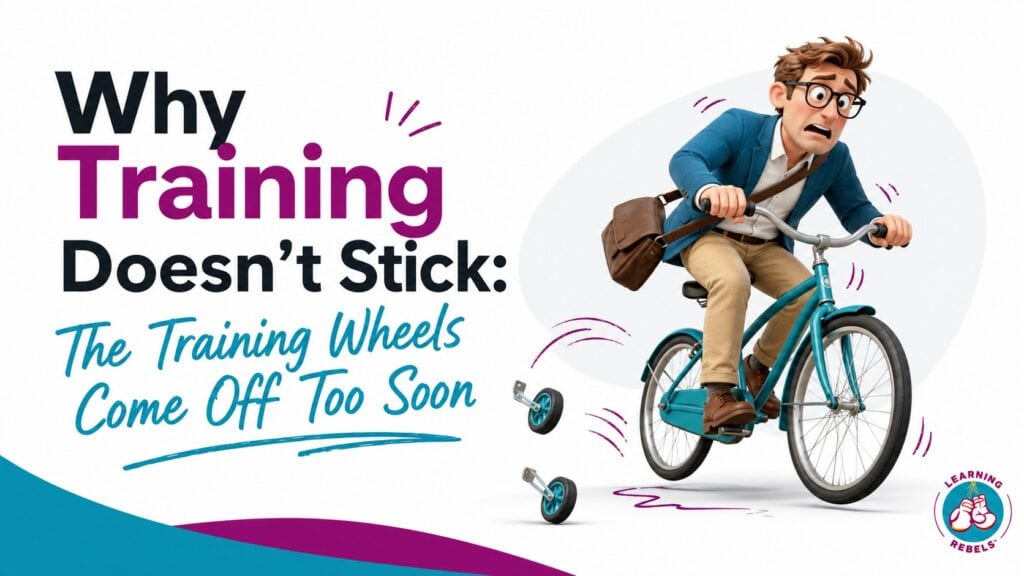
Think about teaching someone to ride a bike. Nobody hands over a two-wheeler and says “good luck.” There’s a sequence: training wheels first, safety basics, a demonstration of how to steer and brake. When the training wheels come off, you jog alongside, or you hold the seat, ready to catch the bike before it topples. You let go a little more each time, only when they’re steady enough to handle it. You don’t just walk away and hope the person doesn’t go tumbling to the ground.
Now picture how a lot of workplace training plays out:
- We show the person a picture of the bike
- Describe how the bike was invented
- Show a video
- Give a demo
- Give the learner a bike with training wheels
- Take the training wheels off, and walk away with a wave and a “Good luck. Call me if you have questions.”
Nobody’s jogging alongside. Nobody’s holding the seat. The person is expected to go from “watched someone else ride” to “fully independent” in the space of a single training event, with nothing in between.
That in-between of “taking the training wheels off and running beside the bike” is scaffolding. Vygotsky’s original idea, the zone of proximal development, is simple: there’s a gap between what someone can do alone and what they can do with help, and the right kind of temporary support closes that gap. The part that gets lost in translation to the workplace is that scaffolding isn’t one thing. There are several distinct types, and most training only ever uses one:
- Modeling: someone demonstrating the skill first (the “here’s how you steer” part)
- Breaking the task into smaller steps: instead of “run the new process,” walking through it as manageable chunks
- Prompts and cues: something to lean on mid-task instead of guessing
- Feedback loops: someone telling them, in real time, whether what they just did worked
- Fading: the deliberate, gradual reduction of reliance on all of the above as competence grows
Here’s what fading looks like in practice. Take a call script for a new sales process:
- Weeks 1–2: the rep is required to read from the script on every call.
- Week 3: the script becomes optional. They can glance at it, but it’s not required to follow it line by line.
- Week 4+: They are expected to work from memory. The script still exists somewhere, as a job aid for a bad day, but nobody’s checking whether it gets used.
The same logic applies to the feedback loop (which is the part of scaffolding that almost gets entirely left out): a manager listening in on every call during week one, every third call in week two, spot-checking by week four.
That’s the fade.
How to handle this in the stakeholder meeting: Don’t ask for longer training. Ask for a fade schedule. A date when listening in goes from required to optional, a manager check-in cadence that gets lighter each week. It’s the difference between “we did a training” and “the skill actually transferred.”
Lever #3: The scaffold nobody plans for…the manager
Here’s the last piece, the managers. We all know that lack of manager support can derail good training all day, every day. But how can we better communicate this need to stakeholders?
Let’s start with how people pick up skills at work in the first place. Albert Bandura’s social learning theory found that a huge share of workplace learning isn’t formal at all, it’s observational.
New hires frequently learn how to handle tasks and workplace norms by watching mentors or peers, and seeing someone else practice a skill successfully builds the observer’s own confidence that they can do it too.
Therefore, your training isn’t the only thing shaping behavior. The people around your trainee are teaching an unofficial course every single day, and if that informal course contradicts what you just taught, it wins. It’s louder and more present.
That’s where the manager needs to come in and where most L&D training plans fall apart: managers are left out of the development process. Remember that feedback loop scaffold from the last section? A manager can’t run a feedback loop on a skill they were never briefed on, weren’t asked about, and had no hand in shaping. And people instinctively pull back from supporting something they weren’t consulted on.
The fix isn’t an email to managers demanding better support. It’s bringing them into the plan before the training happens. A 30-minute conversation where they hear what’s being taught, what “good” looks like, and what one thing they’re being asked to reinforce. Do this and the manager stops feeling like they’re being ambushed and may provide support.
How to handle this during the stakeholder meeting: Let the stakeholders know that you will be looping in the managers and asking for three specific things for them to do after the training to show support for the learning.
- Mention the new skill in a team meeting within the first week
- Ask one “show me how you did it” question within two weeks
- Don’t let anyone get punished for using the new process imperfectly.
Where you can start on Monday
Knowing the levers doesn’t move anything. Here’s where to actually start.
1. Build one retrieval moment into the calendar before you build the training.
Pick one: an automated scenario question sent 5‑7 days out, a 60-second prompt added to a meeting that already exists, or a 15-minute peer pairing. Schedule it when you schedule the training itself, or it won’t happen.
2. Put a date on the fade.
Before the session goes live, decide the exact week the job aid or script stops being mandatory and starts being a reference.
3. Loop the manager in before the training, not after.
30 minutes. What’s being taught, what “good” looks like, and one thing you’re asking them to reinforce.
4. Give managers a script, not a suggestion.
“Support the training” is too vague to act on and too easy to forget. Give them a cheat sheet or checklist to follow.
5. Protect the clumsy phase.
Say it in the room, and say it to managers directly: nobody’s expected to be smooth at this yet, and nobody should be dinged for using the new process imperfectly in week one.
None of this needs a bigger budget. It needs someone willing to jog alongside the bike for a few more weeks instead of letting go the second the training wheels come off.
So the next time someone hands you a date, a topic, and calls it a plan, you’ve got three questions ready: where’s the retrieval, where’s the fade, and who’s handling the manager’s 30-minute “get them in the loop” conversation?
Not sure where to start?
We offer a free curriculum assessment to help you identify your single points of failure and map out what a more resilient process would look like for your organization. No sales pitch, just a practical conversation about what’s working and what’s not.
