
When did shaming the learner become okay?

Lately, in this writer’s humble opinion, L&D (Learning and Development) professionals have been taking a ride on the Bully Bus, looking to create havoc for both their end users and professionals within their own industry.
I suppose the possibility had always been there, I recently wrote a post, “Putting the Human Back into Learning”. In essence, the post was about breaking out of L&D silo’s and stopping the creation of learning programs built for an audience of one (you), and starting to remember we have an end-user. We have a customer, and the customer is the end-user, whoever is on the receiving end of your creation.
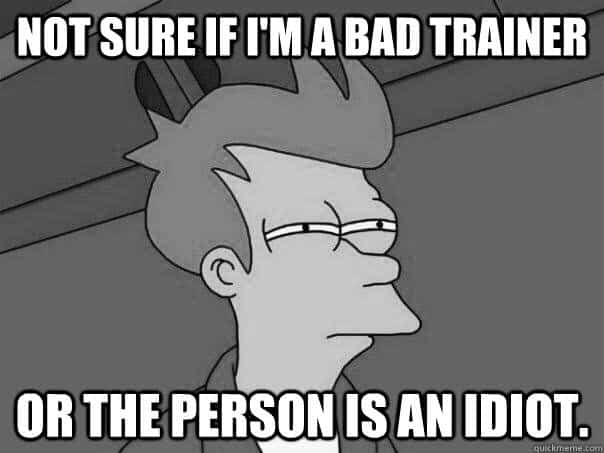
Things have taken an ugly turn.
Not only are we not creating learning for people, we act as if our poor learning design and lack of innovative thought is the learner’s fault.
“I can’t help it if they are too lazy to read.”
“If they can’t figure out how to maneuver within the course, that’s not my fault.”
“Participants don’t get it unless the information is spoon-fed.”
“They just have to understand that ‘this’ is the best way, if they don’t like it…tough.”
“I’m tired of dealing with people who are too hard-headed to understand what I am trying to say.”
Unfortunately, these are common statements. Recently, I was with a group of L&D people, who desperately wanted to blame the user for their poor design work. “We have to “dumb it down”, otherwise ‘they’ won’t understand the (insert topic here).” or my favorite, “We have to spoon-feed the audience, they all have short attention spans – if we don’t tell them what to learn they don’t learn.”
Here’s my question back:
“If you create a course where everyone passes, yet 99% of the people still perform in the way prior to the course – who’s to blame?” It’s not a trick question. Most likely the answer lies with us. We failed somewhere in the design process. We are failing to produce learning that improves performance.
There’s a difference between accountability and humiliation. Accountability helps people improve. Shame makes people hide.
If someone misses expectations or refuses to engage, that’s a performance conversation. But too often, we skip past the performance issue and move straight to sarcasm, public frustration, or blaming the employee for “not caring enough.”
blaming the end-user for our failures as Learning Professionals
Why are we calling them names and questioning their desire to learn? People don’t disengage from learning because they’re lazy. They disengage when learning feels unsafe or, in this case, weaponized.
This is especially true when we can’t tell good design from bad, or worse, when we may not care. This may sound harsh, but it is a harsh reality. We need to seriously wake up, and shake out the cobwebs that have taken root in our brains. We need to do more to make information more accessible, easier to use, easier to find, easier on the eyes, and easier on the brain.
I know, sometimes it’s just easier to blame the victim (and, believe me, people who are participating in poorly designed learning are, indeed, victims). And before we all start pointing fingers at rapid elearning, allow me to clarify – poorly designed learning does not discriminate. It is all-encompassing, from classroom to eLearning to webinars to workbooks. It is all around us, everytime we read an instruction manual that is unintelligible we have poor design, and the human designing it is to blame.
Let’s not blame the tool, blame the person behind the tool.
In the past, we may have been able to put together a workshop, slap a few slides together, and call it a day.
Today, people know their options. They know they can go to YouTube to learn how to successfully install a plumbing feature. Our customers wonder why we don’t use the same techniques.
Perhaps it’s because we are busy blaming them for not understanding materials that seem to be designed by CAL Tech Engineers. Perhaps it’s because we are busy blaming Baby Boomers for their lack of design imagination – because, you know, Baby Boomers don’t like all that technical stuff.
So the next time you reach for your deck of excuses as to why a learning initiative isn’t working, before you blame your customer for your product failure – I ask you to take a long moment and reflect on the real reason for failure. You may find the answer in the mirror.
Bully on the Bus: When L&D Eats Its Own
I am sorry to say the “Bully Bus” has seemed to extend beyond our customers to our own family of Learning Professionals. I see it on Twitter, on LinkedIn, and read about it on blogs. We claim to want divergent opinions and deep questioning, but when expressing those opinions and asking those questions, the troll under the bridge makes an appearance, and it’s concerning.
Example: jump on an L&D or education-based Twitter chat or LinkedIn and ask, “What’s so bad about (ILT) classroom-style learning? I happen to love it.”
The responses will be startling.
You will receive a string of comments questioning your intelligence and sanity. You can almost see the cool kids laughing and pointing at you. And if you’ve spent any time in online L&D spaces, you know exactly what I’m talking about.
There are cliques. There are “popular kids.” There are the same voices amplifying one another, defending one another, pinging outsiders, and deciding which opinions are acceptable this week.
The irony is almost painful. We claim to champion inclusive learning while creating professional communities that can feel socially punishing to anyone who asks the “wrong” question or challenges the preferred narrative.
New people see that behavior immediately. They may not say anything publicly, but they see it. And many decide very quickly that staying quiet is safer than participating.
Have we forgotten our own roots? Many of us did not come up through an L&D career/educational ladder. Remember, “Accidental Trainers”?
And here’s the problem with that behavior: eventually people stop asking questions.
They stop admitting they don’t understand something. They stop challenging ideas. They stop experimenting publicly because nobody wants to be dragged through the comments section for getting something “wrong.” Those who think differently need not apply.
So instead of building a profession full of curious practitioners, we accidentally (or purposefully) create a profession full of people nodding along quietly while Googling answers in another browser tab.
That’s not growth. That’s survival behavior.
What happened to support and respect?
We say we want innovation in L&D, but innovation requires people to take risks by asking questions or sharing ideas that aren’t fully formed yet. You don’t get better thinking by humiliating people into silence. You get safer, smaller, more performative conversations where everyone repeats the same approved opinions because it’s easier than being publicly corrected by the self-appointed guardians of “real” L&D.
It’s just as easy to send someone a helpful link to some research or a book as it is to call them mindless corporate zombies. Looking for a new education-based chat? Try this Reddit feed for instructional designers. Bullies need not apply.
I’ll be the first to admit my frustration and within the archives of this Learning Rebels blog, one would find all sorts of snark and sarcasm.
I will admit to a massive eye roll when debates break out over a piece of research and it’s clear the person in the comments hasn’t fully read the material.
I fully admit to wanting to type “Dumbass, please read before you comment!” Fortunately, I have an inner pause button that prevents me from doing so.
So I just attach the research link (again) to support my position. Smart, deliberate debate requires patience and pausing. What I’m seeing more often is performance disguised as expertise. Fast reactions. Public dunking. Snark mistaken for intelligence.
And honestly? It’s exhausting.
Moving from the Bully Bus to the Love Bug
The challenge is to guide and offer solutions (we are learning professionals after all) – not to punch, jab, and dance away, hidden behind 140 characters or a blog post. I’ve been sitting on this article for a long time now, hoping my observations of meanness were just me. I have started, discarded, and started again countless times.
There have been a couple of people who have beaten me to the punch, namely Patti Shank. Here is her point of view about workplace conflict. After reading her post and having some confidential discussions with new Twitter/LinkedIn users, I knew it wasn’t just me. The “Bully Bus” was real.
When we all look back into our histories, we all started somewhere. I can guarantee the “somewhere” didn’t come with an orientation manual on “How to be a progressive thinking L&D professional”. We had mentors, we read books, and some felt the need to take their curiosity to new levels.
We got to where we are and formed the thoughts we have because someone was kind and generous with their knowledge. If we acknowledge that there are stupid questions, without understanding context, people will stop questioning.
Is this what we want?
Is this our intent?
We shouldn’t be treating fellow L&D professionals like a game of “Whac-A-Mole”.
I suggest we all sit back, take a breath, and reflect.
Reflection about learners. Are we blaming end users for our mistakes? Call your customers and talk to them. Ask them to review your material and then ask how they feel. Yes, how they feel. You’ll get to the “What did you learn?” part eventually, but make sure your customers are feeling good about the experience. Bullies don’t care about the hearts and minds of those around them. They only care about their own results, and we all want to be better – don’t we?
Reflection about how we are treating fellow L&D professionals: Read your tweets, your LinkedIn posts, and your blog (or blog comments). What are your words really saying? Are they encouraging divergent thoughts, or are they dismissive, rude, and mean?
Are you offering coaching, guidance, and advice, or are you playing “Whac-A-Mole”? What is exciting about learning today is that there are so many good options. You may agree with some and have questions about others – and that’s okay. I’ll leave you with this post from Kandy Woodfield who is asking about “The Ethics of Social Learning and Working Out loud”. Great question, and really worth discussing.
Are you one of many who have reacted predictably, or are you really considering her question?
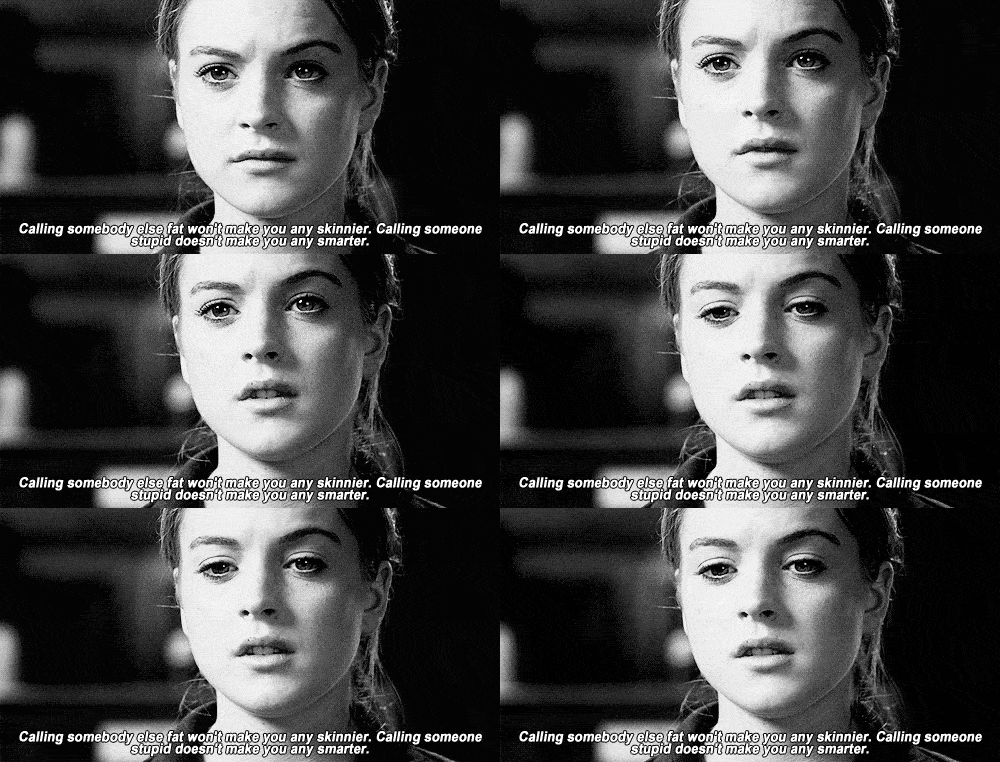
Time to step off the Bully Bus. Let’s begin to support each other, and advocate for, rather than against, our people. No one else will.
Time to share – how are you influencing change in learning today? Tell us your story on how you are doing things differently.
Don’t miss a post. Sign up!
Get new ideas, tips, and information ~ bringing the rebellion directly to you.

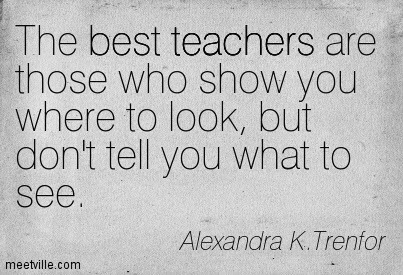
WAY past time to reimagine what “learning and development” means within the corporate setting. I also think we’d help ourselves by stopping the use of the word “learner.” After all, doesn’t it impose a type of ownership on the PERSON as related to our work? Just because you call them a learner, doesn’t mean they’re learning! 🙂
Great point JD and to a certain extent I agree, although I haven’t settled on a term which “feels” right. Student, to me, conjures up a formal learning situation with recess and detention. Employee doesn’t quite do it either. I’ve always like learner because to me it describes the person involved, it’s true the person participating isn’t necessarily learning but I like the mental image, their “job” at the moment is “to learn”. On the flip side, calling a VP a “learner” goes the way of gamification, UGH … so I’m stumped. I’m open – What is your suggestion?