I have a confession before we get into the good stuff. Not long ago, I caught myself saying I don’t have time to read, and then I realized I’d just spent an hour watching baby goats jump around on YouTube. So. Turns out I had the time. I just spent it on baby goats instead of books. In my defense, they were adorable and wearing little goat pajamas.
That’s basically how this Coffee Chat started, and it set the tone for the whole hour: a group of L&D people admitting our reading excuses don’t hold up once we actually audit where our minutes go.
If you’ve never made it to a Learning Rebels Coffee Chat, here’s the deal.
It’s a free, open-discussion session that happens every other Friday, open to anyone in L&D regardless of experience level, and there are no rules except “show up as you are.”
This one landed on the Friday before the Fourth of July, so attendance was light, but the conversation was not. What follows is the recap for everyone who wasn’t in the room and a nudge to grab a seat next time, because you genuinely missed a good one. For all resources associated with this chat, start here (note: link expires on July 17, 2026).
The “I Don’t Have Time” Excuse Doesn’t Hold Up
Here’s the thing I keep coming back to: most of us aren’t actually out of time. We’re out of awareness about where the time goes.
Scrolling while sitting in the waiting room and while waiting in the grocery line. That fifteen minutes of doom-scrolling before bed. None of that is “extra” time you’re protecting for something more important; it’s just time you haven’t redirected yet.
So the group started swapping what “reading in the flow of work” (or, let’s be real, reading in the flow of life) actually looks like:
- Audiobooks during dead time: the commute, the grocery line, the treadmill. Several people in the chat backed this immediately.
- Kindle app + Hoopla + Libby: Brandon made a strong case for this combo. Hoopla and Libby both connect to your local library so you can borrow ebooks and audiobooks for free, meaning your phone becomes a library card instead of a slot machine. His point: when you’re standing in line, you’re going to reach for your phone anyway. This just gives that reflex somewhere better to land.
- Podcasts as a book add-on: a lot of books now have companion podcasts, so you can get more out of a title without adding more reading time. Case in point: Atomic Habits by James Clear has an associated podcast that digs deeper into the concepts between chapters, so your commute or your windshield time can double as reinforcement instead of a whole separate reading session.
None of this requires you to be a “reader” in some noble, curled-up-by-the-fireplace sense. It just requires noticing the fifteen minutes you already have and giving them a better job to do.
Not Every Format Works for Every Brain
Before we even get to whether a book is worth finishing, there’s a more basic question: are you reading it in a format your brain can actually absorb? This group didn’t agree on much here, and that’s kind of the point.
Andrew was refreshingly honest that audiobooks just don’t work for him. He’s trained his brain to treat background audio as white noise. Music, TV, podcasts, all of it, so an audiobook plays and his attention wanders without him noticing. It’s worse with fiction, because he pictures characters as he reads, voice and all, and when the narrator’s voice doesn’t match what his brain already invented, it throws the whole experience off.
Carol is the opposite. She lets Libby read her fiction out loud at 1.75x speed and loves it. A speed she admitted sounded a little unhinged out loud, but it’s her sweet spot.
Same split on physical versus digital, and I’ll out myself here: I’m one of those people who cannot bring myself to write in a physical book. It’s a quirky habit leftover from school, you didn’t write in books. Even now, decades removed from any teacher who’d care, my hand still pulls back the second I reach for a highlighter near an actual page. I know, I know…I said it was quirky.
So I’ve become a post-it note and color-coded sticky tab kinda gal instead, with different colors for different purposes. My Kindle, meanwhile, is highlighted and annotated to death, guilt-free, because somehow a screen doesn’t trigger the same “you’re defacing this” reflex a physical page does.
Other people in the group landed nowhere near that. Brandon’s all about the dog ears. Not to mark his place, but to flag the pages he’s already highlighted so he can find them fast later. Carol can’t make herself write in a book either, but she’s firmly paper-only and doesn’t touch a Kindle. So, I guess to each their own! 😀
None of these is the “right” way to read. They’re just proof that the format matters as much as the content.
Do You Have to Finish a Book? (Group Verdict: No.)
Brandon asked the group a question that turned into one of the best mini-debates of the call: if a book isn’t landing, do you push through to the end, or bail?
The answers split roughly along “did you pay for it” lines. If it was free, thrift store, library, or borrowed, people bailed without guilt. If money changed hands, especially for a hard copy, the sunk-cost guilt kicked in hard. One person put it simply: you don’t always have to read the whole book to get what you need out of it.
I’ll add my own two cents here: sometimes it’s not even the content that loses me, it’s the writing style. I can be genuinely curious about a topic and still not make it past chapter three because the prose is a slog. That’s allowed. Neither the money you spent nor the topic you’re curious about is a good enough reason to force your way through writing that isn’t working for you. Putting a book down isn’t quitting; it’s recognizing you’ve either gotten what you needed or hit a writing style that isn’t worth fighting.
The List: What This Group Is Reading
This is the part you came for, so here’s the rundown (if you’re looking for the 5 books to jump start your L&D career, start here:
(Some links below are affiliate links. I may earn a small commission if you purchase through them, at no cost to you. The recommendations are 100% real, from real people, during the real Coffee Chat.)
Instructional design & presentation craft
- Design for How People Learn by Julie Dirksen
- Slideology by Nancy Duarte
- Crush Your Next Virtual Presentation by Rick Altman
- The Engagement Effect by Steve Spangler
- Make it Stick: The Science of Successful Learning by Peter Brown
Strategy & business thinking
- Value Proposition Design (Strategyzer series) — genuinely useful even outside product design if you think about your L&D function as a brand with a value proposition to defend
- Imagine It Forward by Beth Comstock
- The Power of Moments by Chip and Dan Heath
Professional development
- How to Win Friends and Influence People (Updated for the Next Generation of Leaders) by Dale Carnegie (the “oldie but goodie” that keeps earning its keep)
- The Power of Habit by Charles Duhigg
- The Coaching Habit by Michael Bungay Stanier
- StrengthsFinder 2.0 by Tom Rath
- Anything by John Maxwell the group was split on his writing style, but the underlying lessons hold up. My favorite: nobody climbs the mountain alone. You don’t “win” the mountain by yourself, the team gets you there.
Fiction and the fun stuff
- The Borrowed Life of Frederick Fife by Anna Johnston, described as a total feel-good read
- What It Is, What It Was by Gerald Martinez, a photo-and-history book on 1970s Black action films, because reading doesn’t have to be professional development to count
- Betty White Biography – If You Ask Me: (And of Course You Won’t) by Betty White
- The Amelia Peabody mystery series by Elizabeth Peters, a turn-of-the-century archaeology mystery series with a genuinely strong female lead, recommended as smart, not fluffy
Book Clubs Can Actually Work
One of my favorite parts of the call: a Coffee Chat regular shared how her credit union runs a book-club employee resource group. A few things worth stealing if you’re trying to build reading culture into your org or with friends:
- They take monthly book suggestions from the whole group and use a spin-the-wheel to pick (and record the pick), so it’s visibly fair.
- They theme books to what’s happening that month. A book with a Black protagonist by a Black author for Black History Month, a book with a strong woman lead and written by a woman for Women’s History Month. It ties the club to DEI programming without being heavy-handed about it.
- There’s no pressure structure. No assigned chapters, no discussion homework. The rule is simple: if it’s not fun, it’s not working.
- Leadership at her company reads work-relevant content too, and instead of just assigning a title top-down, they pair it with a clear expectation of what to do with it. As I said on the call, it’s easy to bring reading into an org when it’s a mandate from the top. It’s much harder, and much more valuable, to actually do something with it afterward.
If you’re trying to build any kind of reading or learning culture at your org, that’s the blueprint: crowdsource it, give it a light theme, keep the pressure off, and always pair the “read this” with a “here’s what we’re doing with it.”
The Reading Tips, Straight From the Chat
At the end, I ran a quick chat blast, and everyone dropped their best reading tip at once. Here’s what came in:
- Try Paperback Swap a credit-based site where you trade books you’ve finished for ones you want, instead of buying everything new.
- Listen to audiobooks while walking.
- Read 30 minutes before bed instead of scrolling or watching TV.
- Carry your Kindle everywhere. it removes the “I don’t have a book with me” excuse entirely.
- Take notes in a separate journal so you can go back to your thinking later, not just the book’s.
- Make time for yourself. Sounds obvious, but gets forgotten constantly.
Your Move
Nobody needs a twelve-book summer reading list sitting in their Kindle reading list, judging them. Pick one thing below and actually do it this week. That’s it. That’s the whole ask.
- Download Hoopla or Libby and connect it to your library card before the week is out.
- Pick one book from this list that matches your interest right now.
- Audit one dead-time slot in your day (commute, lunch line, the fifteen minutes before bed) and swap the scroll for a chapter or a podcast episode.
- If a book isn’t working for you, put it down. No guilt tax required.
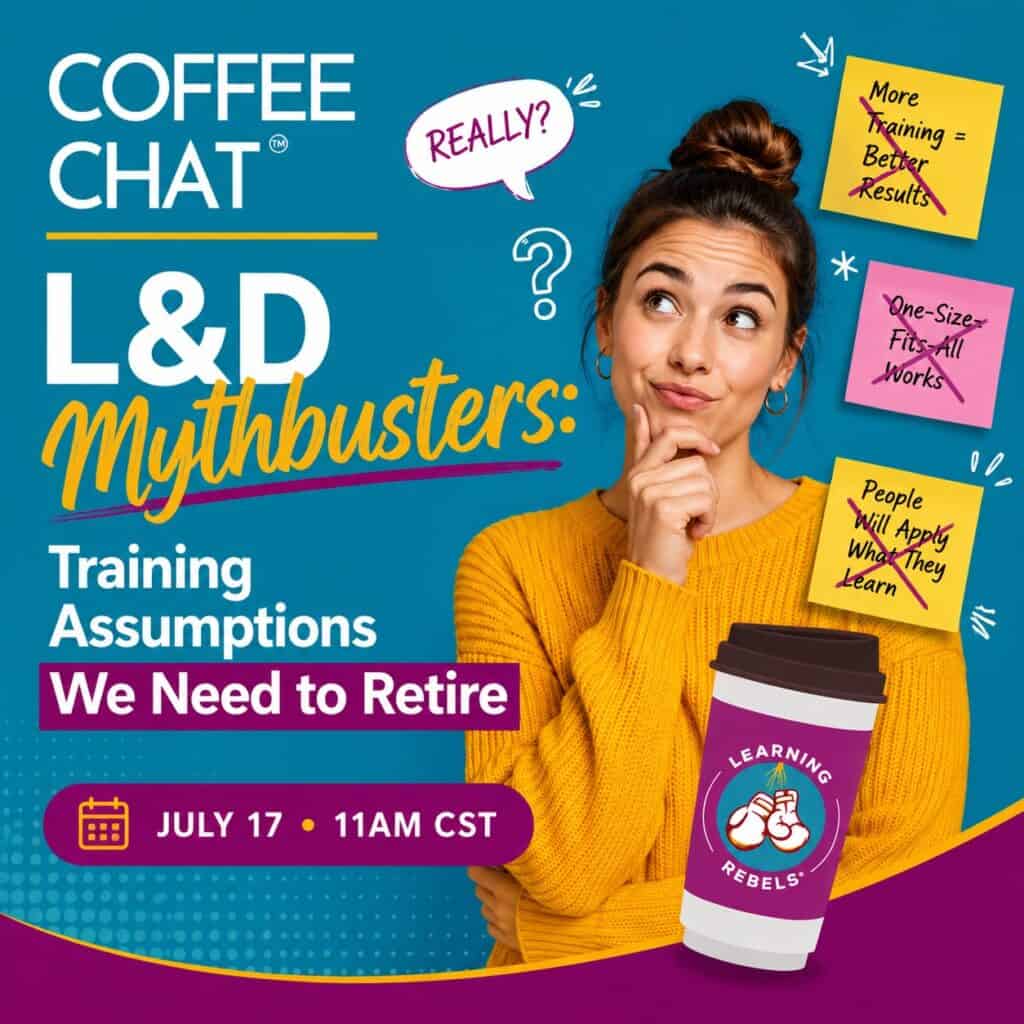
And if you want to keep this conversation going, join us for the next Learning Rebels Coffee Chat. It’s free and open to everyone in L&D, no matter where you are in your career. Next, we’re tackling the learning myths that just won’t die. You don’t want to read the recap of that one. You want to be in the room.
Loved the book club structure that the credit union built? That’s not luck, that’s design. If you’re trying to build a community of practice at your org: an energizing book club, a peer learning group, an internal podcast, anything that gets people actually connecting instead of just completing modules. I help organizations build these from scratch so they actually stick.
