
Why is Teaching Critical Thinking so hard?
Can we talk about the critical thinking workshop for a minute?
I’ve seen more versions of it than I can count. They mostly include the same things. A “How I communicate” icebreaker with a “5 Whys” handout. And at the end, everyone has an “A-HA” moment to put on their reflection sheet.
But then?
Monday morning happens. The call center is still escalating the same calls. The project status reports still say “on track” right up until they don’t. And the leader who asked for the workshop is back in your inbox: “The training didn’t work! We still need people who can think critically.”
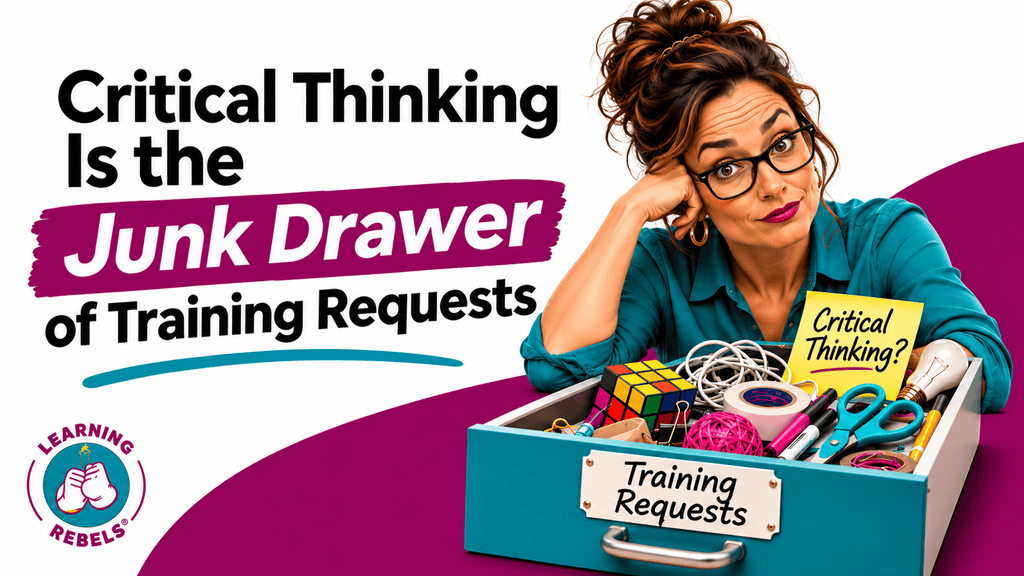
That request is the junk drawer of training. Leaders toss in every frustration they can’t quite name, and most of what lands in there has nothing to do with how people think or work.
Here’s what’s going on. There are two kinds of critical thinking training, and most organizations try to implement the wrong one.
- Blanket thinking treats critical thinking as a general skill. It’s taught on its own, separate from the work, and it’s the same for everyone in the room.
- Job thinking treats critical thinking as part of the work itself. It’s taught through the job, shaped by what this role, this customer, and this business actually need.
Most critical thinking training is blanket thinking. However, what most leaders want is job thinking results. Closing that gap starts with understanding how thinking works on the job.

Same question, three different jobs
Blanket thinking assumes that once you learn to “ask good questions,” you can ask them anywhere about any thing. This is why the concepts within your standard “critical thinking” workshop don’t stick.
Take one classic critical thinking question, “What am I missing?”, and give it to three different people in three job roles.
- A call center rep has about 90 seconds to figure out why the customer is actually calling. For them, “What am I missing?” means hearing the real problem behind the complaint. The customer asking about a billing error may really be deciding whether to cancel.
- A project manager asks it about the risk nobody put on the status report. It’s the team that says “on track” every week while the one dependency they’re waiting on hasn’t moved in a month.
- A systems architect asks it about what breaks later. The design works today, but what happens when usage triples, or when the one person who understands the integration leaves?
Same question. Three completely different kinds of thinking. A blanket workshop can teach the art of questioning. It can’t teach the call center rep what to listen for, the PM which risks matter more than others, or the architect what’s likely to break. That part comes from knowing the job.
Cognitive scientist Daniel Willingham has been making this point for years.
Thinking isn’t like riding a bike, a skill you learn once and use anywhere. It’s tied to what you know. You can tell someone to look at an issue from multiple perspectives, but if they don’t know much about the issue itself, then they can’t think deeply about it. (Willingham, Critical Thinking: Why Is It So Hard to Teach?).
And this isn’t a new problem. Back in the 1990s, researchers found that most college faculty called critical thinking a top teaching goal, but only a small fraction could clearly explain what it was (Foundation for Critical Thinking). The same is true in corporate training. We’re trying to teach something we haven’t clearly defined.
So it’s not about asking good questions. It’s about asking the right questions for this job, this customer, and this business need.
Sometimes it isn’t a thinking problem at all
Here’s the part your stakeholders don’t love hearing. Remember that junk drawer? “We need critical thinkers” is where every frustration goes when nobody can name the underpinning problem.
And “critical thinking” is the perfect label for that drawer.
First, nobody can argue with critical thinking training. Who’s going to say, “Actually, we’d prefer people who don’t think”? Second, it puts the problem inside employees’ heads and frames it as their issue. That conveniently shifts the blame and keeps it away from process and procedure issues like approval processes that make zero sense, an overly complicated CRM system, or a manager who couldn’t hold an update meeting if it came with a handle.
Putting people through “training” is a lot easier than admitting nobody feels safe making a decision because fear overrides logic.
Picture the call center from earlier: A leader complains that the call center team “can’t think on their feet” and keeps transferring calls to supervisors. Now, go sit with the team for an hour, you’ll see a different picture emerge. Reps are measured on “time to handle” and any refund over $50 needs supervisor approval. The last rep who used their judgment on a tricky account got written up for it. The lesson learned is that thinking is risky.
Open the critical thinking drawer in almost any organization and you’ll find the same suspects:
- People who escalate everything. Nobody told them what they’re allowed to decide, or the approval limits are so low that every decision is above their pay grade.
- People don’t push back on bad ideas. The last person who did got shut down in front of the team.
- People “don’t think things through.” The team has 14 priorities, and the manager rewards speed over accuracy.
- People accept whatever the AI says. Nobody has defined what “checking it” means, plus there’s no time to do it.
- People repeat the same mistakes. Nobody tells them how their decisions make an impact until something blows up.
None of those are thinking problems. They’re system problems. Send those same people to a critical thinking workshop and they’ll come back with a shiny new framework, but they’ll have the same approval limits, the same metrics to hit, and the same manager who shuts them down whenever they speak.
Here’s a quick gut check, adapted from Robert Mager and Peter Pipe’s classic Analyzing Performance Problems: if their job depended on getting it right, could they do it? If the answer is yes, you don’t have a skill gap. You have a system telling people there are other priorities.
That’s why the first move isn’t designing training. It’s figuring out the symptoms. (If you land on “this isn’t a training problem,” here’s what to do next.)
What job thinking looks like in 2026
AI makes this distinction even more critical. When an answer is one prompt away, the valuable skill isn’t finding answers. It’s knowing whether the answer is any good.
Researchers at Microsoft and Carnegie Mellon surveyed 319 knowledge workers who use AI tools every week. People confident in their skills thought more critically about the AI’s output. People who were less confident in their skills put less thought into the AI’s output and trusted it more (The Register).
Read that again with your L&D hat on. The people who questioned the machine were the ones who knew the work. That’s job thinking in action, and it’s exactly what a blanket workshop can’t supply. It’s also why fewer early-career practice opportunities should worry us: when AI takes the grunt work, people lose the practice their judgment depends on.
So what does a critical thinker look like at work in 2026? Three things:
- They question the answer. Not “Is this true?” in general, but “Is this right for this customer, this project, this system?”
- They know the work well enough to notice when something’s off. A PM who has run a dozen rollouts sees every status report saying green and asks why the vendor has gone quiet for two weeks.
- They own the call. They make the decision and stand behind it, instead of hiding behind the tool or the boss. (Which only works if the boss doesn’t punish them for it.)
Turn Critical Thinking into job thinking
The next time someone asks for “critical thinking training,” here are three questions that will tell you whether you’re dealing with a thinking skills gap or a system gap:
- What decision is going wrong? Ask for a real, recent example. “They don’t think” isn’t an example. “Our reps refunded a customer who’d already been refunded twice” is.
- What does good thinking sound like in this specific role? This is the big one. It forces the leader to define job thinking instead of asking for slogan thinking.
- What’s getting in the way? If the answer is knowledge or practice, you can build something. If it’s authority, time, or fear, you’ve found a system problem, and critical thinking training won’t fix it.
If it is a thinking skill gap, write the outcome around the job, not the slogan. Here’s the difference using Learning Rebels’ Human-Based Learning Outcome framework:
- Blanket thinking: “Participants will strengthen their critical thinking skills.”
- Job thinking: “Be able to evaluate AI-generated recommendations by checking them against three source questions so that YOU catch errors before they reach the client in order to reduce rework and protect client trust.”
The first one is your standard LO, it looks nice on a slide and to stakeholders. The second one tells you what thinking will look like, what to practice, and what to look for afterward. Because thinking takes repetition, plan for practice over time, not in one event. You can’t take the training wheels off too soon.
What are we missing?
Here’s the part I find a little funny. When a leader asks for critical thinkers, that request becomes a critical-thinking test for L&D. The blanket-thinking response takes it at face value and starts the design process. The job-thinking response asks the same question we’d want from any good employee: What am I missing?
For L&D, what we’re usually missing is the real problem the leader tossed into the junk drawer and labeled “critical thinking.” Sometimes it’s a real skill gap you can build practice around. Sometimes it’s a refund policy, a scorecard, or a manager who shuts people down. Either way, you’ve done exactly what the leader asked for. You thought like the job, and in L&D, the job is figuring out what’s really wrong before you build anything.
Grab the tool: Is It Really a Critical Thinking Problem?
A 4-page worksheet and decision tree for L&D pros who’ve been asked for “critical thinking training.” Test the request, find out whether it’s a thinking gap or a system problem, and define what critical thinking actually looks like in the role.
Not sure where to start?
We offer a free curriculum assessment to help you identify your single points of failure and map out what a more resilient process would look like for your organization. No sales pitch, just a practical conversation about what’s working and what’s not.
