
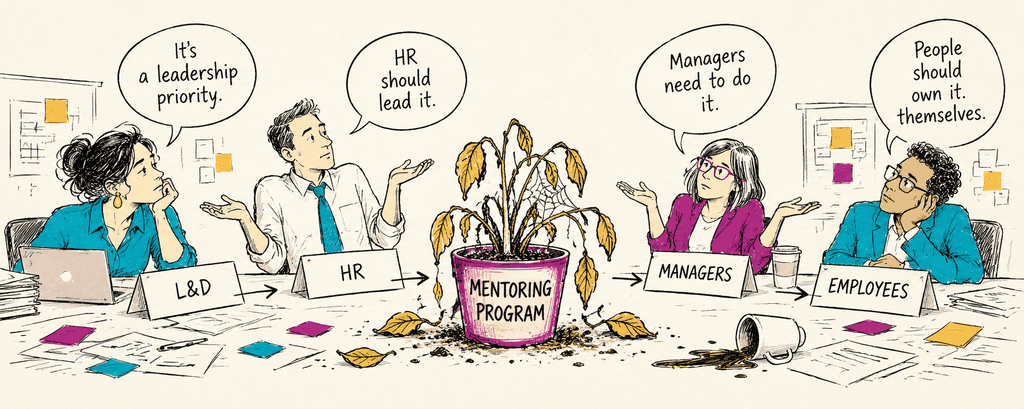
“Can you put together a mentoring program?”
It usually shows up as a drive-by. A leader leans into your doorway (or your Teams chat) right after a meeting where someone said “high potentials” and “succession planning” in the same breath.
“Nothing crazy. Just something to help our up-and-comers.”
You say yes. Of course you say yes. Mentoring is a good idea, and you know it.
So you start sketching out ideas. Somewhere around the third draft of the project plan, it hits you. Everybody wants this program. Nobody has said who’s going to own it.
Who’s protecting the time? Who’s making sure the check-ins happen? Who’s going to ask, six months from now, whether any of this is working?
And we all know, if nobody answers those questions up front, the answer becomes you.
The issue is that when leadership doesn’t own the program, it’s on a fast track to failure, and that’s a shame, because mentoring works when it’s done right. The research most leaders have heard of is a Gartner study of Sun Microsystems’ mentoring program. Retention for mentees came in at 72% and for mentors at 69%, compared to 49% for employees who didn’t participate. Mentees were also promoted five times more often than people without mentors (Knowledge@Wharton).
Yes, that study is old enough to vote. But it’s still the number everyone reaches for when they make the case for mentoring, and it’s easy to see why. Those numbers are hard to argue with.
At the end of the day, leadership wants results. They just haven’t fully understood their role in the mentorship game.
So here’s what I’d like you to know before you build a single thing: L&D builds the spine of a mentoring program. Leadership decides whether it walks.
Two halves of the same coin, and the program only works when both get done.
Coaches and Mentors Aren’t the Same Player
Before we talk about who owns what, we need to clear up a mix-up that derails many mentoring programs.
People use “coaching” and “mentoring” like they’re interchangeable. They’re not, and the difference changes everything about how you build this thing.
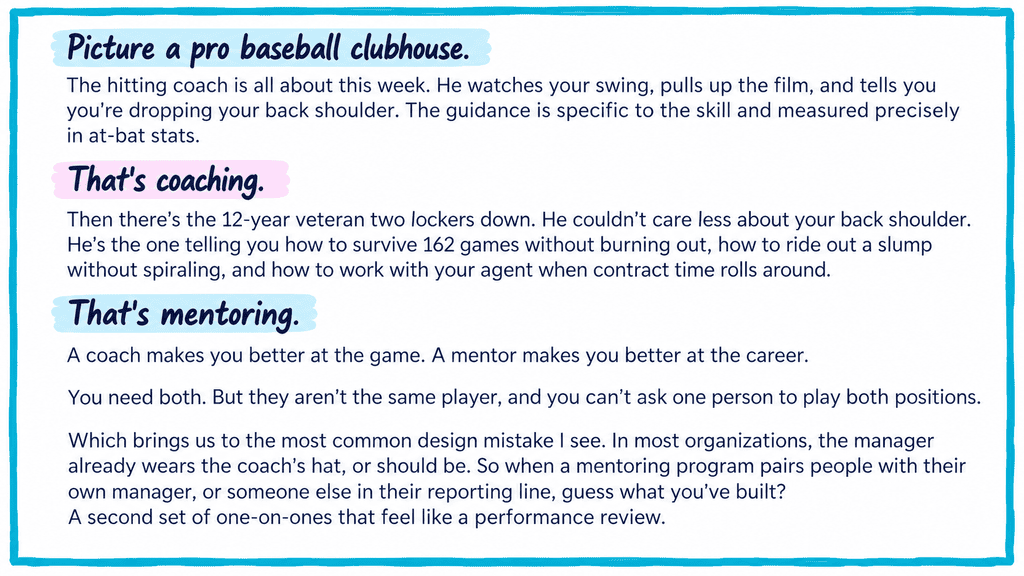
Think about it from the mentee’s side. Nobody is going to tell the person who writes their performance review that they’re not sure they even want to manage people. Or that they’ve been struggling with burnout. Or that they’re completely lost on how budgets are established.
Those conversations need someone outside the chain of command. Someone whose advice isn’t filtered through their own slice of the org chart.
So the next time someone in a kickoff meeting uses “coaching” and “mentoring” like they’re the same thing, you’ll be the one who can say, kindly, “Those are two different jobs, and the difference changes how we approach this program.”
Failure points to ownership
So you’ve got the right players on the field. Coaches over here, mentors over there, and nobody pairing people with their own boss.
Good. Now let’s talk about why mentoring programs still run out of gas, even the well-designed ones.
You’ve seen this movie before:
The program launches with everyone meaning well. There’s a kickoff with a senior leader saying some strong words about “investing in our people.” Everyone leaves with a shiny new mentoring guide and the best intentions to schedule calendar meetings.
Month one, most pairs meet.
Month two, a few meetings get bumped for “something urgent.”
Month three, you’re the one sending cheerful reminder emails, chasing people for check-in surveys, and wondering whether anyone above you has mentioned the program since the kickoff.
No shocker: they haven’t.
Then another leadership meeting rolls around, and someone asks whether that mentoring “is working,” and the real answer is that nobody has paid attention to it long enough to really know.
Here’s what I need you to hear: that’s not a design failure, and it’s not your failure.
It’s because of a system that lets everyone with real authority applaud the launch and then walk away from their part. It’s the same trap I wrote about in Your Onboarding Has a Single Point of Failure. When one person or one department carries the whole thing, then the whole thing is only as strong as that one person.
L&D can build a mentoring program that sets people up to win. Leadership has to make sure people actually show up and do their thing.
Once you see it that way, the question in your head changes. It stops being “Where did I fail in the design?” and becomes “Who agreed to own their part of this, and did we hold them accountable by writing it down?”
Let Me Tell You About the Dating Game
I learned all of this the practical way, working with a national recreation organization.
They had a familiar problem. Their high potentials, the people being groomed for management, weren’t learning what made their successful managers successful. On paper, they had a mentoring program. In practice, it paired each person with someone in their own area, most often someone in their own reporting line.
You can probably guess how that went.
The conversations stayed polite and safe. Nobody was about to tell their boss they weren’t sure they were ready for the big chair.
So we rebuilt it.
Participation stayed voluntary, with the high potentials raising their hands to be mentored. But the program itself became formal and structured, with clear expectations, a defined timeline, and actual check-ins.
One of the biggest changes was the matching. Instead of assigning mentors, we created a bank of potential mentors and let the mentees do the choosing.
Think the Dating Game, only for mentees.
People picked mentors whose path, perspective, or skill set they wanted to learn from, not whoever happened to sit nearby. That one shift changed everything about how invested people were, because they’d chosen their person based on their unique needs, not logistics.
We also didn’t leave the mentors to wing it. Being great at your job doesn’t automatically make you great at helping someone else figure out theirs. So we built short microlearning pieces just for the mentors: how to ask better questions, how to listen without jumping to fix, how to work through hard conversations.
And here’s what made it stick: leadership didn’t applaud the kickoff and disappear. Senior leaders stayed in regular contact with the mentors, checking in on how the pairs were going and what support they needed. When a pair stalled, someone with real authority asked why.
The mentors knew leadership was paying attention, so they kept showing up. That’s what it looks like when leadership owns their part.
But what about the results, you may ask?
- Turnover with high-potential managers dropped from 32% to 21% in the first 18 months.
- Feedback said conversations were more relevant. Mentees talked about the stuff that mattered, because they’d picked someone safe to talk to.
- The mentors got better, too. They told us the structure made them stronger mentors and more empathetic managers overall. Their own frontline employees backed that up in 360 feedback, with better scores on items like “my manager listens to me,” “I look forward to coming to work each day,” and “my manager supports my growth.”
That last bullet still makes me smile.
We set out to develop future managers and ended up making the current ones better along the way. A nice unexpected result.
I’d like you to note that it wasn’t fancier content or a bigger budget that changed. It was choice, structure, and actual support for the people doing the mentoring.

The Mentor Spine: What L&D Builds
So what does L&D actually own here? The structure. The bones that hold everything up so nobody has to reinvent it each time a new pair gets matched.
Keep it lean. A mentoring program doesn’t need a 40-page playbook. It needs five things done well.
1. A purpose tied to something the business cares about. “Developing our people” is lovely, but it’s not a purpose. Is the goal getting high potentials ready for management? Keeping new managers from flaming out in year one? Holding onto institutional knowledge before a wave of retirements? Pick one. It shapes every decision that follows, and it’s what leadership will care about when you report back.
2. A mentor bank and a matching approach. Recruit mentors who are willing, not voluntold. Give mentees real choice, or at least a real say. And keep matches outside the reporting line, for all the reasons we covered with the hitting coach and the veteran.
3. A cadence and an end date. How often do pairs meet, and for how long? Six to nine months with monthly conversations is a reasonable starting point. An end date matters more than people think. It gives everyone a finish line and you a natural moment to evaluate.
4. Prep for the mentors. This is the piece most programs skip, and it’s the one that made the biggest difference in my mentor development story. Make the support bite-sized and practical. How to ask good questions, how to listen without fixing, and what to do when the conversation gets real.
5. A way to know it’s working. Decide upfront what you’ll track. Participation is the floor, not the goal. Look at what you tied the purpose to: retention, promotion readiness, internal moves, engagement scores. Keep it simple enough that you’ll actually collect it.
That’s the spine. Want it mapped out by phase, from design to launch to the six-month check? That’s exactly what the Mentoring Action Map download is for.
Leadership Walks the Talk
Now for the part that makes or breaks the whole thing.
A spine without muscle just lies there. Leadership is the muscle. And when I say leadership owns this, I don’t mean a signature on the project charter. I mean five things that feed each other like links in a chain:
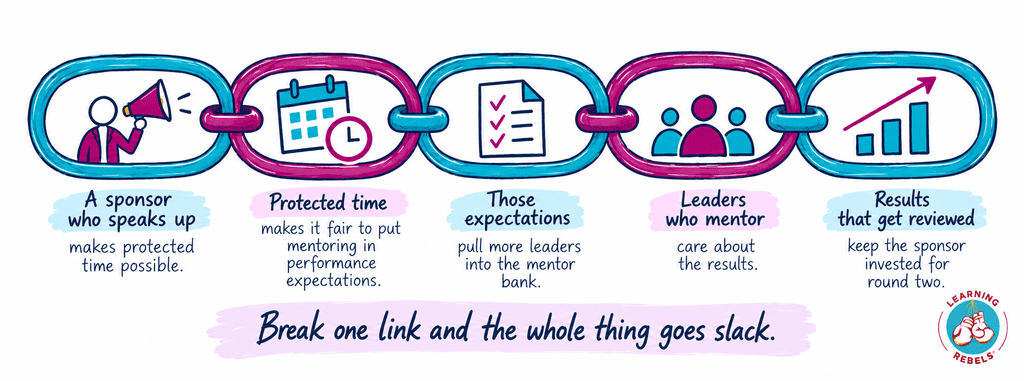
- A named executive sponsor. A person, not a title. Someone whose name is on the program and who’ll talk about it out loud, more than once.
- Protected time. If mentoring has to compete with everything else on the calendar, mentoring loses. Every time.
- Mentoring baked into leaders’ performance expectations. What gets measured gets done, and what gets left off the review gets left off the calendar.
- Leaders who mentor. Nothing signals “this matters” like a VP in the mentor bank.
- Leaders who review results. Not just approving the launch, but sitting down at the six-month mark and asking what’s working.
Here’s why it’s a chain and not a checklist. A sponsor who speaks up makes protected time possible. Protected time makes it fair to put mentoring in performance expectations. Those expectations pull more leaders into the mentor bank. Leaders who mentor care about the results. And results that get reviewed keep the sponsor invested for round two.
Break one link and the whole thing goes slack.
Here’s how the work splits:
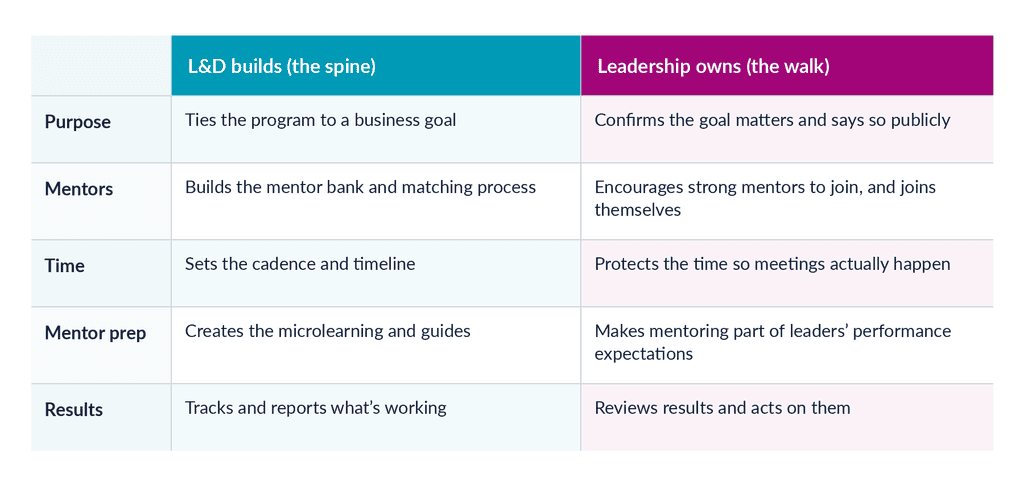
And when it’s time to have the conversation, it can be this simple:
“I’m excited to build this. I’ll handle the structure, the matching, the mentor prep, and the tracking. For it to work, I need a few things from leadership: a named sponsor, protected time for the pairs, and someone to sit down with me at the six-month mark and look at results. Can we agree on who that is today?”
That’s what I call strengthening your chain.
Before You Build: Four Quick Wins
You’ve got the chain set up. Here’s what to do this week so you walk into that leadership conversation with more than good ideas.
- Grab a baseline before anything launches. Pull the current turnover, promotion, or internal-move numbers for the group you’re targeting. If you don’t know where you started, you can’t show how far you’ve come, and the six-month review turns into a vibes check.
- Talk to two people who’ve been mentored well. Ask them one question: “What made it work?” Their answers will tell you more about what your mentor prep needs to cover than any template will.
- Ask your future mentees what they’re hungry to learn. A short survey or a few hallway conversations will do it. What do they wish someone would explain to them? Who do they already admire? That’s the raw material for your mentor bank and your matching.
- Think pilot, not launch. Start with one cohort of eight to ten pairs. A small group lets you work out the kinks, gather a success story or two, and give your sponsor something real to talk about before you scale.
So, Now What?
The next time a leader leans into your doorway asking for “nothing crazy, just a mentoring program,” you don’t have to choose between being agreeable and being realistic.
You can be both.
“Absolutely. Here’s what I’ll build. Here’s what I need from you.”
That one sentence changes the whole conversation. It tells leadership you’re ready to do the work, as long as they are too.
And remember what happened at that recreation organization. A program built to develop future managers made the current ones better, too. That’s the real payoff of getting ownership right. You’re not just running a program. You’re helping build a bench of leaders who know how to grow the next ones.
Not bad for something that started as a drive-by.
Not sure where to start?
We offer a free mentoring program review. We’ll look at what you have (or what leadership is asking for), spot where ownership is likely to slip, and map out who needs to own what before you launch. No sales pitch, just a practical conversation about what’s working and what’s not.
